How my process has changed
Five years ago, I would:
-
Read industry reports.
-
Estimate market size using secondary data sources.
-
Develop a priori buyer personas from primary and secondary research.
-
Do a deep dive on maybe the closest 10-12 competitors.
-
Create and continually update working artefacts.
-
Synthesise information and create a handful of maps or matrices to find patterns.
-
Interview or survey customers.
In 2026, my process looks like this:
-
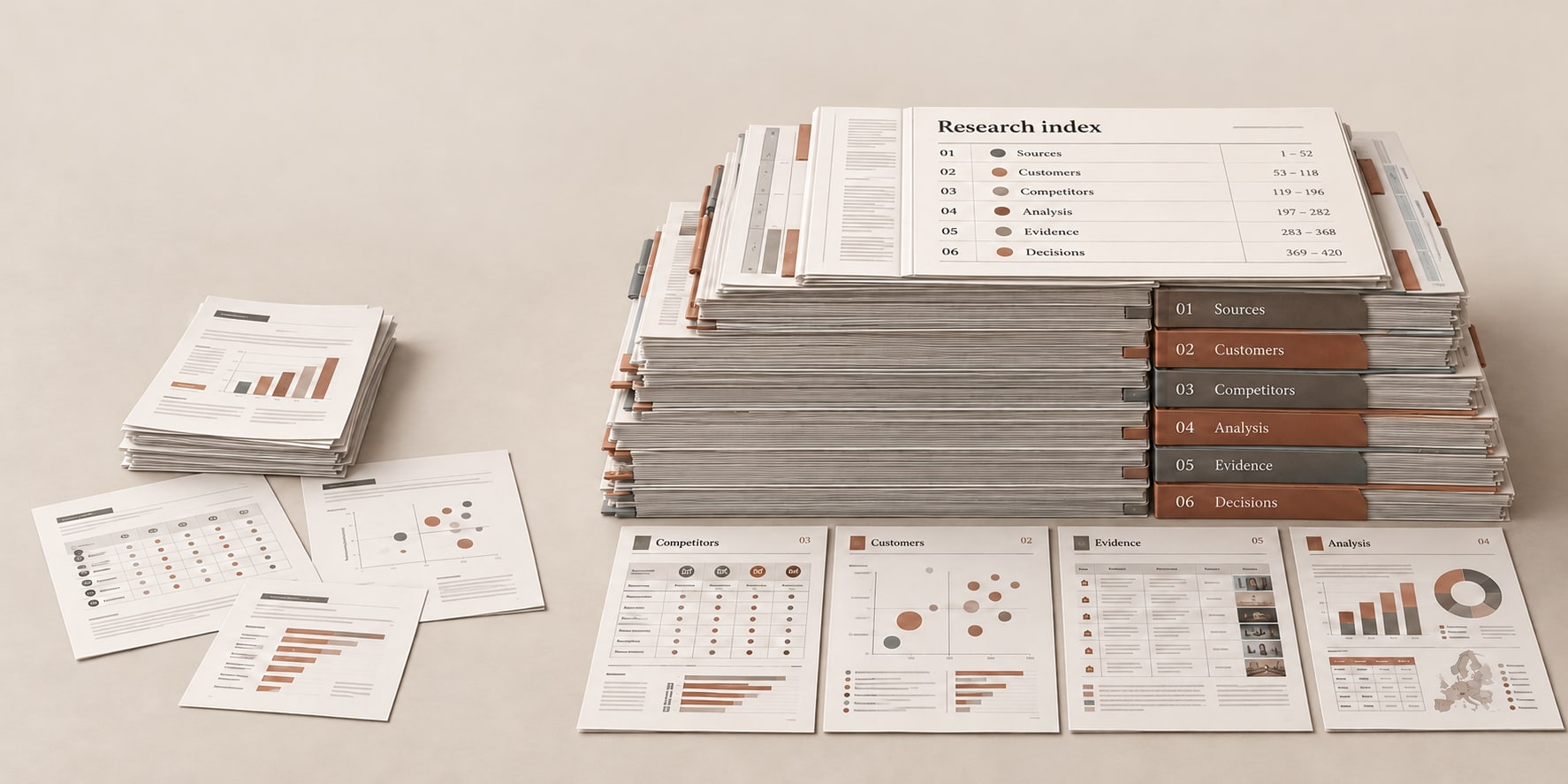
Build a database covering the category as comprehensively as possible.
-
Add hundreds of industry reports, articles and company documents, including company filings.
-
Collect company website content - current and archived versions - to see direction of travel.
-
Scrape consumer information from relevant websites like Trustpilot, G2, Clutch, Reddit, X.
-
Interview or survey customers, then add transcripts and survey responses to the database.
-
Perform AI-assisted clustering and categorisation to identify groups and themes.
-
Ask AI to flag disagreements between sources, distinguishing reported claims, recorded observations, and inferred insights.
-
Pull owned client info into the database (eg aggregated CRM, prospect call transcripts, strategy docs, roadmaps) to mine trends and gather observations and insights, finding common vernacular and pain points, or points of disagreement or incoherency.
-
Log and index observations, analyses, insights and project conversations in a shared repository.
-
Get AI to analyse competitor brands’ offers and messaging (carefully calibrated and QA’d with a pre-defined evidence register and decision log) and identify attack surfaces or opportunities for differentiation.
-
Push updates to working documents in tools like Miro and Google Docs/Slides in seconds.
The upshot for execs receiving the deliverables is as follows:
-
It’s much faster. What used to take me ~3 months full-time now takes ~6 weeks part-time.
-
The analysis is broader AND deeper. More companies studied. More reports read. More customers spoken to. More datasets involved and analysed.
Context gathering and synthesis
To understand how, we need to dig into the fundamentals a bit.
Strategy is a simple concept: “How do I best achieve my goal, given the context I am operating in?”
Context can include external actors, competitive environment, customer behaviour, organisational challenges and natural advantages, available resources, operational constraints, even the laws of physics.
Within strategy exercises you have 2 sub-phases related to context:
-
Context gathering
-
Context synthesis
Gathering establishes what we know. Synthesis combines individual pieces of evidence and observations to identify patterns, relationships and higher-level insights that would not be apparent from examining each piece individually.
The core value from a strategy exercise is from synthesis. The more relevant and reliable context you have, the greater your opportunity to identify meaningful patterns and challenge your initial assumptions.
Obviously you cannot synthesise context you have not gathered. But - at least in theory and ceteris paribus - the more context you have (assuming it is ‘truth’), the better the strategy will be.
Therefore, the goal of the strategist is to be able to synthesise context in ways that are a) correct, b) difficult for others to copy, and c) ideally, non-obvious.
What does this have to do with AI?
Before and in the early days of AI, context gathering was - relative to now at least - time-consuming, imperfect, and incomplete. Budget or time allotment determines the number of industry reports you can purchase and read, the number of customers you can speak to, the volume of desk or field research you can conduct.
Now, speaking from my own experience, you can compile a ‘database’ of hundreds of industry reports, the entire market of competitors, proprietary internal data like CRM, and internal documents like company financials and operational realities, customer interview transcripts, and scraped web data, in a few (roughly 5-10) days.
Previously, this level of context gathering would have taken weeks, if not months. AI has collapsed this part of the process by 80%+.
Three problems with AI conducting the gathering
-
Dataset bias. While AI is very good at understanding the dataset it is given, it is not good at knowing whether that dataset represents a flawed or incomplete model of the market.
-
Source relevance and reliability. AI can blur differences in what sources establish. A Reddit discussion may reveal customer nomenclature, while a reputable industry study may support a market-size estimate. It needs to be told what sources can be used for what insights or analysis.
-
Intangible context. Much of what drives business decisions and market movement is intangible context that either cannot be, or is rarely, written down. Things like:
-
The risk appetite of the CEO, board, or senior management.
-
Societal zeitgeist.
-
Sales team incentives.
-
Prevailing organisational culture.
-
Historical baggage from failed initiatives.
-
Organisational memory of customer behaviour and psychology, developed over years or decades.
-
How I handle these issues
-
Setting the perimeter of the analysis explicitly rather than implicitly.
-
Documenting known coverage gaps.
-
Defining differences between core concepts, like facts (verifiable), observations, insights, and hypotheses.
-
Setting and calibrating source categories and ratings.
-
Maintaining an evidence register that links claims to sources for auditability.
-
Adding relevant internal evidence, such as call transcripts, and checking inferences about risk appetite or culture directly with the people involved.
So while I am still involved in the gathering task, I am a definer, shaper, and calibrator, not the gatherer myself (for most of it). This provides an extremely broad, and rich, dataset for the next phase - synthesis.
Synthesis
A dataset like this is more context than any human can hold in their head, and in turn derive useful insights. Not so for AI. AI is able to find patterns and spot gaps and ambiguities at a much larger scale, and significantly faster, than a human.
Synthesis is where a strategist would traditionally earn their keep. Someone who can absorb a large amount of information and identify relationships that other people missed could develop materially better insights, and in turn, strategic recommendations.
Five years ago I would create a handful of maps to ‘visualise the market’. It would take days, be subject to my own biases, and be a small subset. I now do this in minutes or hours, with less subjectivity, across the whole market.
I still need to think about the implicit biases within the AI models, but by-and-large they are far less prone to self-selection bias, recency bias, confirmation bias, and a myriad of other biases than humans get blindsided by.
AI has squeezed the human advantage in synthesis. This may sound gloomy, but it is actually a good thing. To understand why, we need to split synthesis into distinct intellectual tasks:
-
Pattern identification. What relationships or regularities exist?
-
Pattern interpretation. Why does this pattern exist? What explains it?
-
Significance assessment. Does this pattern matter to the decisions we need to make?
AI has a clear advantage in 1, especially with statistical and clustering tasks. Though it does still need steering, especially with the aforementioned ‘intangible context’ to find and validate these patterns.
The biggest benefit is that AI makes it much cheaper to test another direction. For executives, this can mean:
-
More investigations conducted.
-
More alternatives considered.
-
Clearer evidence trails for recommendations.
-
And therefore, in theory, better strategic recommendations.
Where the strategist adds value
Where a human strategist must therefore increasingly operate is in the pattern interpretation and significance assessment space - interrogating and understanding why patterns exist, understanding if patterns are useful, actionable, or consequential, designing additional investigation needed to resolve uncertainty.
It is not that AI cannot do this, but in my experience so far, this is where AI is less competent than a good strategist. And this is where the skill in identifying and incorporating the ‘intangible context’ - zeitgeist, organisational culture, individual personalities, market movement, unique and deeply human customer insights - is what AI cannot do well.
In 20 years time, we will look back on how strategy projects were done up until 2025 as some folksy, quaint process, like how we view driving to a shop in the 90s to rent a video today.